
Stop Betraying Yourself with Holiday Spending: A Trauma-Informed Approach
There’s a moment every holiday season when you feel yourself crossing a line you promised you wouldn’t cross.
Maybe you buy gifts out of guilt.
Maybe you overspend to avoid conflict.
Maybe you swipe your card even though something inside you whispers, “This isn’t aligned.”
And afterward… the shame arrives.
Not because of the money itself—but because you abandoned yourself in the process.
If this is your cycle, breathe.
You’re not irresponsible.
You’re not “bad at money.”
You’re not lacking discipline.
Holiday overspending is often a trauma response—not a character flaw.
Your system is trying to create safety, soothe old wounds, or prevent emotional discomfort in the only way it learned how.
Let’s unravel why this happens… and how you can choose alignment instead of self-betrayal this year.
Why Holiday Overspending Is a Trauma Response
Overspending rarely comes from desire.
It comes from:
pressure
guilt
fear
survival patterns
unhealed family dynamics
subconscious money imprints
Here are the deeper roots behind it:
1. You learned early on that giving = safety
If you grew up in a household where peace depended on pleasing others, then giving becomes a nervous-system strategy.
You might overspend because your body believes:
“If I give enough, I’ll be accepted.”
“If I take care of everyone, it won’t explode.”
“If I go above and beyond, I’ll stay safe.”
This isn’t generosity.
It’s survival loyalty.
This is where having a grounding process that helps you pause before reacting becomes essential.
2. You’re soothing emotions with spending
Holiday intensity can trigger:
loneliness
grief
comparison
old wounds
sensory overload
anxiety around family
Overspending becomes a momentary exhale—a way to give yourself the comfort you never received.
Your brain interprets buying as regulation, not indulgence.
When your system is overloaded, what you need is a gentle reset that rebuilds internal capacity.
3. You’re reenacting old worthiness wounds
If you were conditioned to earn love, praise, or belonging through sacrifice, your spending might be carrying an emotional weight.
You overspend because:
you don’t want to disappoint
you’re afraid of being seen as “less than.”
you’re compensating for an old sense of inadequacy
You’re not buying gifts—you’re buying safety from rejection.
The first step is noticing this pattern with compassion, not judgment.
Then choose a practice that helps you respond from presence instead of fear.

4. Stress collapses your decision-making capacity
Holiday overwhelm shrinks your window of tolerance.
When your nervous system is tired:
impulse control decreases
clarity dissolves
urgency rises
fear gets louder
boundaries get softer
You’re not making choices—your survival brain is.
When clarity feels out of reach, try small daily shifts that bring your system back into alignment.
Even tiny shifts can change the outcome.
5. You’re trying to avoid family conflict
Many people buy gifts strategically—not lovingly.
to avoid criticism
to appease a parent
to keep the peace
to sidestep hurt feelings
Overspending becomes emotional armor.
Recognizing this truth is powerful.
It means you’re not reckless—you’re protective.
And your body is trying to shield you.
How to Choose Alignment Instead of Self-Betrayal
Overspending stops not through willpower… but through honoring yourself.
Here are trauma-informed ways to shift the pattern:
1. Slow down before the purchase
Before you shop, ask:
“What part of me wants to buy this?”
If the answer feels like pressure, fear, guilt, or urgency—pause.
This is the perfect moment for a grounding sequence that helps you return to center.
2. Come back into your body
Self-betrayal happens when your mind overrides your body.
Try:
one long exhale
feeling your feet
relaxing your tongue
placing a hand on your heart
These simple somatic cues interrupt automatic patterns.
If your system is too charged to slow down, use a simple reset that rebuilds regulation gently.
3. Make choices from truth, not obligation
Ask yourself:
“Does this feel true for me?”
“Is this aligned with how I want to spend?”
“Am I honoring myself?”
Guilt is not intuition.
Fear is not generosity.
Obligation is not love.
4. Create spending boundaries that support your nervous system
Not restrictive boundaries—stabilizing ones.
Try:
a limit per person
a limit per event
a maximum number of gifts
choosing presence over presents
choosing honest communication instead of silent sacrifice
Boundaries that come from truth support your system.
Boundaries that come from fear drain it.
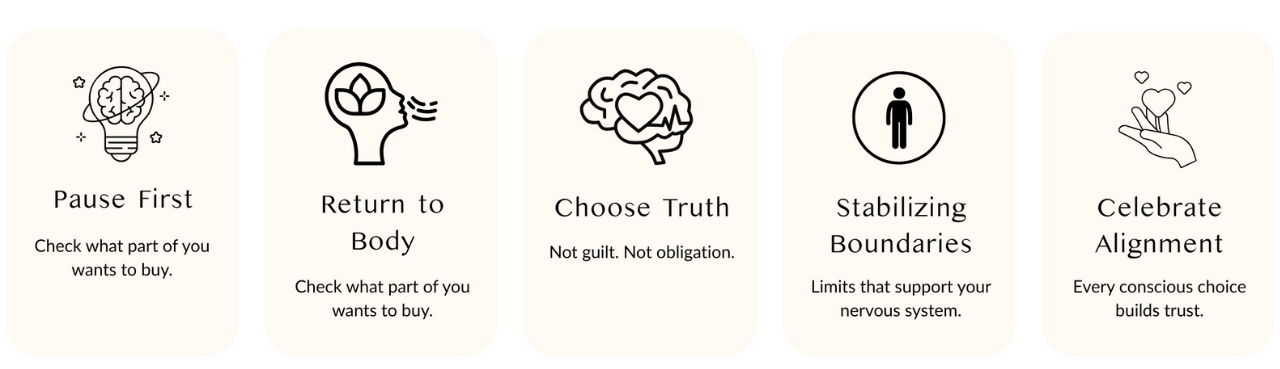
5. Celebrate every moment you choose alignment
Every time you:
say no
pause
spend consciously
choose yourself
…you are breaking a trauma pattern.
You are teaching your system a new way of being.
You are building internal trust.
You are becoming someone you feel proud to follow.
You Don’t Have to Abandon Yourself to Be Loved
Overspending is often a symptom of an old wound—not of irresponsibility.
You deserve relationships where your worth is not tied to what you give away.
You deserve holidays where you don’t sacrifice yourself to be accepted.
You deserve to choose from alignment, not fear.
Because you deserve all good —
Not some.
Not a few.
But all.
If you want support shifting these patterns, here are the next steps.
✨The ROAR Method
A grounded, compassionate process that helps you interrupt survival spending patterns, return to presence, and make aligned choices without pressure.
✨ The 5-Day Reset
A gentle, step-by-step rhythm that rebuilds regulation and capacity so you can stay connected to yourself—even in high-trigger moments.
You can also explore additional support or deepen your work through Private Sessions.
